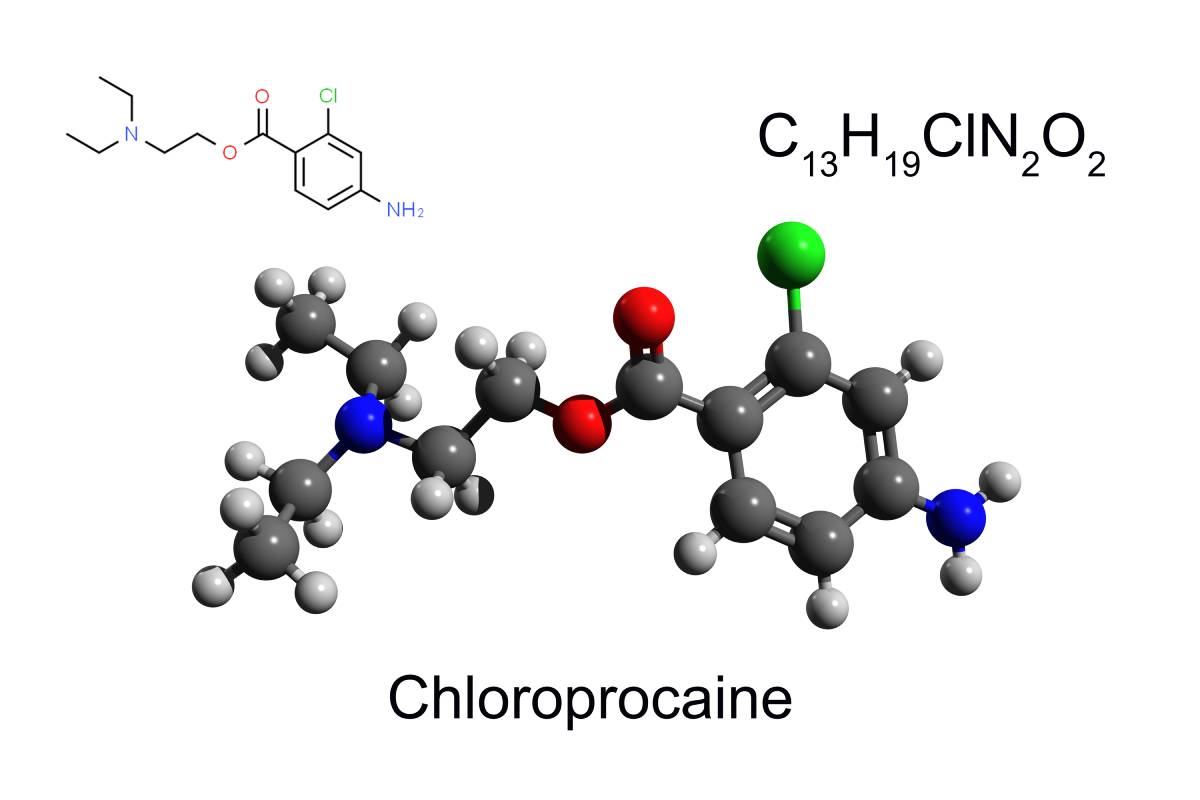
Chloroprocaine is a local anesthetic with a number of indications. It can be injected into the spinal theca (intrathecal injection) to produce a spinal block, which numbs the legs and lower parts of the body; it can be used for local anesthesia via infiltration (direct injection into tissue), peripheral, and central nerve block; and it can be given in the form of an epidural or caudal block.1 Its advantages include its rapid onset, short duration of action, fast recovery, and low risk of transient neurologic symptoms, which together make it a favorable choice for short procedures; it’s also favorable for caesarean deliveries since there’s very little risk of maternal or fetal toxicity.1 Some consider it the local anesthetic with the safest toxicological profile.2 Different indications may require different chloroprocaine formulations.
A 1% solution is typically used for situations requiring short-acting, localized pain relief, such as infiltration anesthesia and peripheral nerve blocks. Like other local anesthetics, chloroprocaine is formulated in a water-based solution. The 2% solution is also used for short procedures, such as short upper limb surgeries,3 while the 3% solution is typically used as part of the epidural anesthesia in caesarean deliveries, where the onset of anesthesia is urgent.
Traditionally, chloroprocaine formulations contained the preservatives sodium bisulfite and ethylenediaminetetraacetic acid (EDTA) to prolong shelf life. In the 1980s, however, reports emerged of neurotoxicity from inadvertent subarachnoid injection of epidural doses of chloroprocaine, and it was hypothesized that the preservatives were to blame.4 In response, preservative-free chloroprocaine was developed: Clorotekal, a preservative-free chloroprocaine solution, was approved by the FDA in 2017 for intrathecal injection and was deemed non-inferior to the local anesthetic bupivacaine in phase 2 and 3 trials.5
Some formulations of chloroprocaine contain the antimicrobial preservative methylparaben, but they should not be used for spinal or epidural anesthesia due to potential neurotoxicity.6 The same is true for benzyl alcohol preservatives.
Chloroprocaine is a weak base, but it is typically formulated as a hydrochloride salt, which is acidic in solution. Increasing the pH of local anesthetics by the addition of a base can make the solution less irritating and hasten the onset of action. In one study, the use of buffered chloroprocaine led to fast and effective anesthesia during the first stage of labor.7
In September 2022, the FDA approved a topical formulation of chloroprocaine for use as a local anesthetic for the eye, which is necessary for certain eye procedures like cataract surgery and laser procedures like LASIK. Here, chloroprocaine is used as a 3% gel that is applied as an eye drop. The anesthetic, which is preservative free and long lasting, was equivalent to the topical local anesthetic tetracaine in a head-to-head trial in regards to how effectively it achieved ocular surface anesthesia.8 Furthermore, patients receiving tetracaine reported higher pain scores than those receiving chloroprocaine. In another study, despite being a high viscosity gel, chloroprocaine was found to not interfere with the bactericidal effects of povidone-iodine, which is applied during eye operations to prevent infection and inflammation.9
References
1. Tonder, S., Togioka, B. M. & Maani, C. V. Chloroprocaine. in StatPearls (StatPearls Publishing, Treasure Island (FL), 2025).
2. Covino, B. G. Pharmacology of local anaesthetic agents. Br. J. Anaesth. 58, 701–716 (1986), DOI: 10.1093/bja/58.7.701
3. Sulyok, I. et al. A randomised, non-inferiority study of chloroprocaine 2% and ropivacaine 0.75% in ultrasound-guided axillary block. Sci. Rep. 11, 10035 (2021), https://doi.org/10.1038/s41598-021-89483-y
4. Kim, D. H. et al. Chloroprocaine Provides Safe, Effective, Short-Acting Spinal Anesthesia Ideal for Ambulatory Surgeries: A Retrospective Review. HSS J. 16, 280–284 (2020), 10.1007/s11420-019-09713-y
5. Regulatory Decision Summary for Clorotekal. https://dhpp.hpfb-dgpsa.ca/review-documents/resource/RDS1733408271619.
6. Hetherington, N. J. & Dooley, M. J. Potential for patient harm from intrathecal administration of preserved solutions. Med. J. Aust. 173, 141–143 (2000), 10.5694/j.1326-5377.2000.tb125570.x
7. Ackerman, W. E., Herold, J. A., Juneja, M. M. & Sweeney, N. J. Effect of position on the spread of buffered 2% chloroprocaine administered epidurally for the second stage of labor. South. Med. J. 83, 277–279 (1990), 10.1097/00007611-199003000-00005
8. Figus, M. et al. Chloroprocaine 3% Gel as a Novel Ocular Topical Anesthetic: Results from a Multicenter, Randomized Clinical Trial in Patients Undergoing Cataract Surgery. J. Ocul. Pharmacol. Ther. 40, 117–125 (2024), 10.1089/jop.2023.0096
9. Ilyas, H. & Costine, R. The Effects of Low Viscosity Preservative-Free Chloroprocaine Ophthalmic Gel 3% versus BAK-Containing Tetracaine 0.5% on the Bactericidal Action of Povidone-Iodine. Clin. Ophthalmol. 18, 825–831 (2024), 10.2147/OPTH.S454496