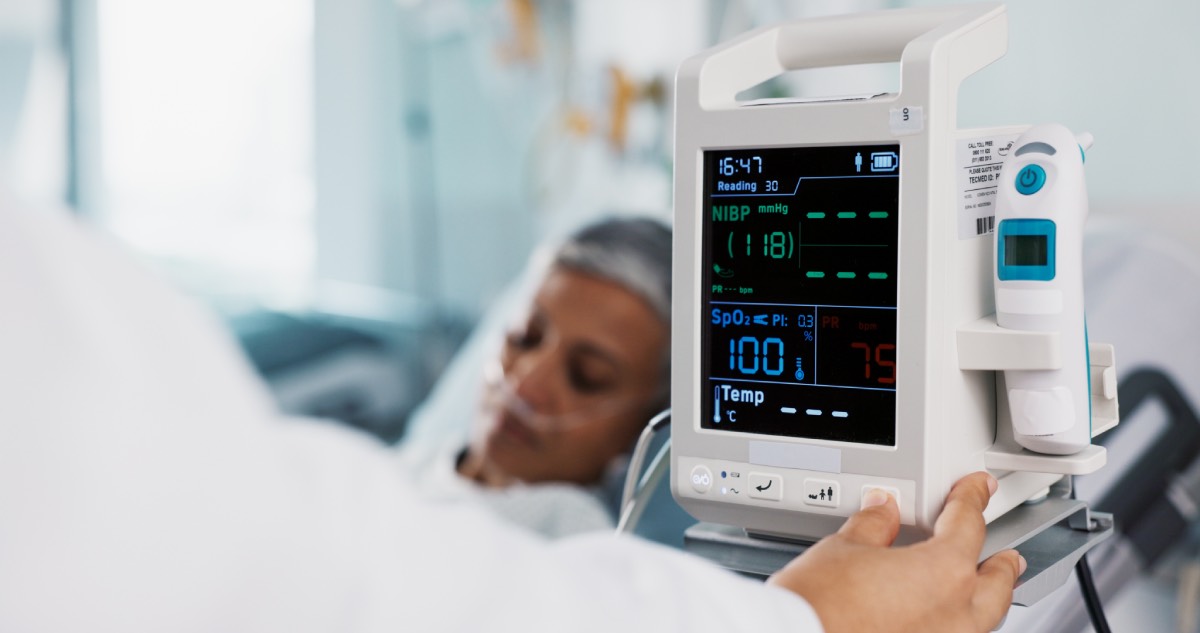
The feasibility of continuous postoperative monitoring has increased as medical technology has advanced, bringing with it the potential to improve patient safety after surgery, as adverse physiological events can occur after patients have left intensive monitoring environments. Traditional postoperative care relies on intermittent nursing assessments, which may fail to detect clinically significant episodes of hypoxemia, hypotension, or tachycardia (1).
Advances in wireless wearable monitoring technology now allow continuous surveillance while preserving patient mobility and comfort, making implementation more practical in routine hospital settings. As hospitals continue to prioritize prevention of postoperative complications, continuous monitoring systems are gaining attention as a means of improving early recognition of complications in patients.
Research has demonstrated that clinically significant physiological abnormalities are commonly missed during intermittent monitoring. Sun et al. found that postoperative hypoxemia was both common and persistent, with many prolonged episodes undetected by standard nursing checks (1). Likewise, Turan et al. reported that postoperative hypotension frequently occurred without recognition during routine ward monitoring (2).
These findings are clinically important because sustained hypoxemia and hypotension have been associated with increased risks of myocardial injury, respiratory compromise, intensive care admission, and postoperative mortality. Continuous monitoring systems therefore provide an opportunity for earlier intervention before physiological instability progresses to severe complications. Recent evidence supports both the effectiveness and operational feasibility of continuous postoperative monitoring. In a cluster randomized crossover trial involving 798 patients recovering from noncardiac surgery, Khanna et al. compared continuous unblinded monitoring with conventional intermittent assessment (3).
Patients receiving continuous monitoring experienced significantly less time with oxygen saturation below 90%, spending approximately 30 fewer minutes in desaturation during the first 48 postoperative hours. Although reductions in hypotension and tachycardia were not statistically significant, overall measures of physiological instability improved.
Importantly, the investigators demonstrated that wearable wireless devices could be integrated effectively into surgical ward workflows through centralized alarm systems and mobile nursing alerts. Earlier recognition of instability likely enabled nurses to provide prompt interventions such as oxygen administration, airway repositioning, and respiratory stimulation, helping to reduce the severity and duration of respiratory compromise (3).
Additional studies further support the benefits of continuous postoperative monitoring. Eddahchouri et al. observed reductions in unplanned intensive care unit admissions and rapid response activations after implementation of wireless continuous monitoring systems (4). Similarly, Rowland et al. reported improved clinical outcomes among surgical ward patients receiving continuous wireless monitoring compared with standard intermittent assessment (5).These findings suggest that continuous surveillance can be incorporated into existing postoperative workflows without substantially disrupting routine patient care. Modern wearable systems are also less restrictive than traditional bedside telemetry, allowing greater patient mobility and comfort during recovery.
Despite these benefits, several barriers continue to limit widespread implementation. Alarm fatigue remains a major concern because excessive alerts may desensitize healthcare staff and reduce responsiveness to clinically important events. Financial costs associated with equipment, infrastructure, and staff training also present challenges for hospitals. Nevertheless, advances in wireless technology, artificial intelligence–assisted alarm filtering, and integration with electronic health records may improve efficiency and reduce unnecessary alerts in the future.
Overall, current evidence supports the technological and clinical feasibility of continuous postoperative monitoring and the clinical benefits it can provide. Wireless monitoring systems can reliably identify physiological abnormalities commonly missed during intermittent assessments and may allow earlier interventions that improve patient safety. Although further large-scale studies are needed to determine the full impact on mortality and major postoperative complications, current research strongly supports the growing role of continuous postoperative monitoring in enhancing postoperative outcomes.
References
1. Sun Z, Sessler DI, Dalton JE, et al. Postoperative Hypoxemia Is Common and Persistent: A Prospective Blinded Observational Study. Anesth Analg. 2015;121(3):709-715. doi:10.1213/ANE.0000000000000836
2. Turan A, Chang C, Cohen B, et al. Incidence, Severity, and Detection of Blood Pressure Perturbations after Abdominal Surgery: A Prospective Blinded Observational Study. Anesthesiology. 2019;130(4):550-559. doi:10.1097/ALN.0000000000002626
3. Khanna AK, O’Connell NS, Saha AK, et al. Continuous vs Intermittent Postoperative Vital Sign Monitoring: A Cluster Randomized Crossover Trial. JAMA Netw Open. 2026;9(3):e263290. Published 2026 Mar 2. doi:10.1001/jamanetworkopen.2026.3290
4. Eddahchouri Y, Peelen RV, Koeneman M, Touw HRW, van Goor H, Bredie SJH. Effect of continuous wireless vital sign monitoring on unplanned ICU admissions and rapid response team calls: a before-and-after study. Br J Anaesth. 2022;128(5):857-863. doi:10.1016/j.bja.2022.01.036
5. Rowland BA, Motamedi V, Michard F, Saha AK, Khanna AK. Impact of continuous and wireless monitoring of vital signs on clinical outcomes: a propensity-matched observational study of surgical ward patients. Br J Anaesth. 2024;132(3):519-527. doi:10.1016/j.bja.2023.11.040